Justice Barrett’s Puzzling Legal Philosophy
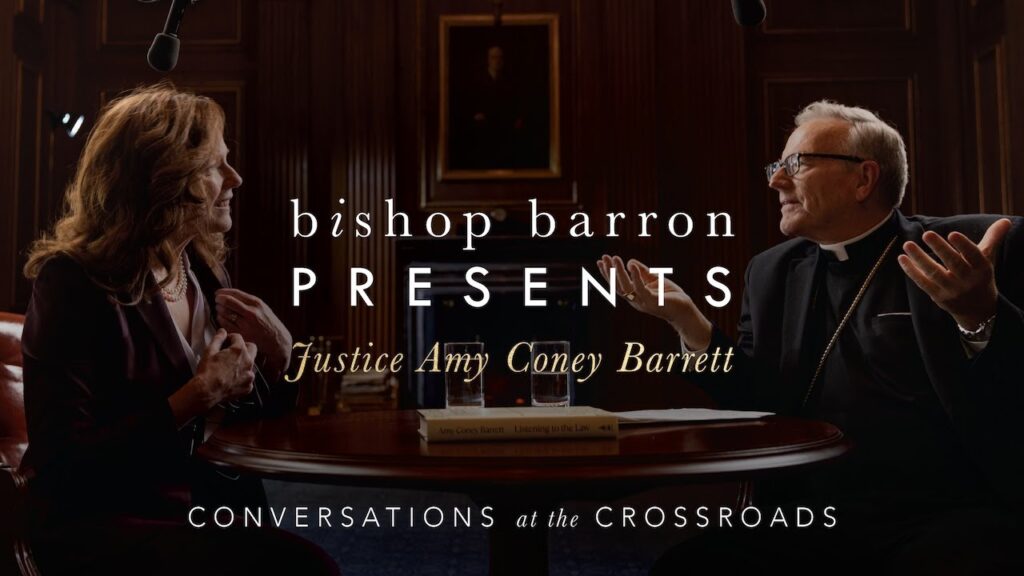
I will start by confirming that I am impressed and inspired by Justice Barrett. In a recent interview with Bishop Barron, Supreme Court Justice Amy Coney Barrett gave an enlightening insight into her life both on the bench and away from it. She discussed various topics and one in particular, that has puzzled me is the subject of this blog.
When discussing the concept of law, there is a myriad of answers you can receive from legal scholars, and their philosophical thoughts are extremely interesting. This happens to be the case with a Supreme Court Justice.
This is a subject that fills law libraries and I am not entertaining to resolve the issue here, but Justice Barrett provided, what I believe to be, a contradictory position within her answer on where her legal philosophy lies.
I want to briefly discuss what was said within the interview and highlight the contradiction I believe was in her answer and would hope any comments would provide some clarity for me.
Please read on and let me know if I have heard what she said correctly and if it is a contradiction. Let me know your thoughts.
What happens when a Bishop sits down with a Judge?
This interview flourished from the release of Justice Barrett’s new book. She discussed her upbringing and her family, her legal career, being a professor of law and now a Supreme Court Justice.
As would be expected, some of the juicier cases she has been involved in were discussed as well as her legal philosophy. Bishop Barron discusses the relationship between law and religious theology and asks Justice Barrett about that.
She discussed one of the best plays / movies of all time, namely Robert Bolt’s A Man For All Seasons. I was pleased to discover that the line that stays with her is the same line for me. But this was not the reason for this blog, it was the conflicting statement she made regarding her comments on originalism and that she believes in natural law.
It is this subject matter that I will discuss below as this position is incongruous with her statement.
Comments regarding originalism.
Around the 21:15 mark, Bishop Barron raises the subject of originalism and the influence of Justice Scalia on the formation of Justice Barrett’s approach to law. To declare how he understands originalism he gave some definitions and then asked Justice Barrett to comment on this.
Of course, she expounds upon this articulately referring to clarity of the writing and how the reader interprets the original document of the Republic. It is all very enlightening. She clarifies that this is not hermeneutics. This concerns the ratification by the states and how it was understood at the time.
They discuss living constitutionalism and this leads into Justice Barrett clarifying that Congress should be the entity that allows the constitution to evolve. According to Justice Scalia, where living constitutionalism is concerned, the danger is allowing 9 judges to make changes to the constitution.
This of course leads to one of the biggest challenges in law, the dichotomy between ‘is and ought’. One of the greatest philosophers on this issue was of course, David Hume, who lived between 7 May 1711 – 25 August 1776. Hume challenges Natural Law Theory in many ways. One of the most important questions Hume asks is, “Who gets to decide what to change”?
Justice Barrett and Natural Law.
At the 29:33 minute mark, Justice Barrett states “I believe in Natural Law and I believe in the common good”. This is revealing regarding her theoretical philosophy. As an originalist, she is a positivist. However, believing in Natural Law Theory contradicts this.
The founding fathers posited the constitution and the amendments that followed have also been posited, stating what the law is. This is a positivist point of view. This is juxtaposed to the natural law position, which (simply) states that there is a meta-physical force that influences what law ought to be.
This can be understood by acknowledging her faith as a Roman Catholic which for clarity, I am also. I am not criticising Justice Barrett’s private religious beliefs as they reflect my own, but I am criticising how they influence her judicial position of positivism.
Why Hume Shows Justice Barrett To Be Wrong.
During my PhD, I wrote about Hume to support my epistemology that the banks were not the cause of the Great Financial Crisis. I stated:
“Extending from this feeling, comes the rationale that the banks must be prevented from doing this in the future. Regulation is introduced based upon these feelings with the support of propositions ‘ought’ and ‘ought not’ and not the expected propositions of ‘is’ and ‘is not’. This predisposition to lean almost imperceptibly into moral discourse is fundamentally flawed. It is impossible for natural law to result from the natural world. Such an abomination is antinomous as the natural law, or the ought, is demonstrated via a feeling. This, ought, develops a relation that cannot be deduced from the natural world or the is. It is impossible to demonstrate how one is derived from the other”.
Of course, this stems from Hume’s A Treatise of Human Nature (Classy Publishing 2023) 321 – 322. Although written in the 18th century, it highlights the discussion that has surrounded positivism and natural law theory for centuries. It is still an ongoing debate, and one it seems, that confuses Supreme Court Justices.
Is this important?
I would argue that it is important. Justice Barrett comments on the fact if a judge is happy with every decision they make, then they are not an honest judge. Indeed, as a perceived part of the right-wing influence within the Supreme Court, she has been criticised by observers for not supporting what they consider right-wing issues. The one person, who has not complained about her, is President Trump, he has publicly supported her.
This perception of Justice Barrett not supporting supposed right-wing issues, relates directly to the comments she made during the interview with Bishop Barron. She is well reasoned, honest and highly educated. There is no doubt she has a brilliant and acute legal mind as was evidenced in her senate hearings in 2020.
If there is some confusion by those on the right regarding some of Justice Barrett’s decisions, it is not because she is out of her depth or some other disrespectful opinion, it leans more to the conflict in her belief in natural law and the belief and search, for the common good.
Hume noticed the antimony of this position centuries ago and it seems as though Justice Barrett has openly stated that this is a conflict with her legal philosophy. I wonder if she is consciously aware of this or if I have conflated her position and assumed this is an issue for her.
Tell me what your thoughts are.
Let me know what you think. Do you agree with me that there is a conflict between natural law theory and being an originalist? Does Justice Barrett have the correct balance between originalism and the search for the common good? What are your legal philosophies? Let me know if you are an originalist, positivist, natural law theorist or some other proponent of a different legal philosophy.